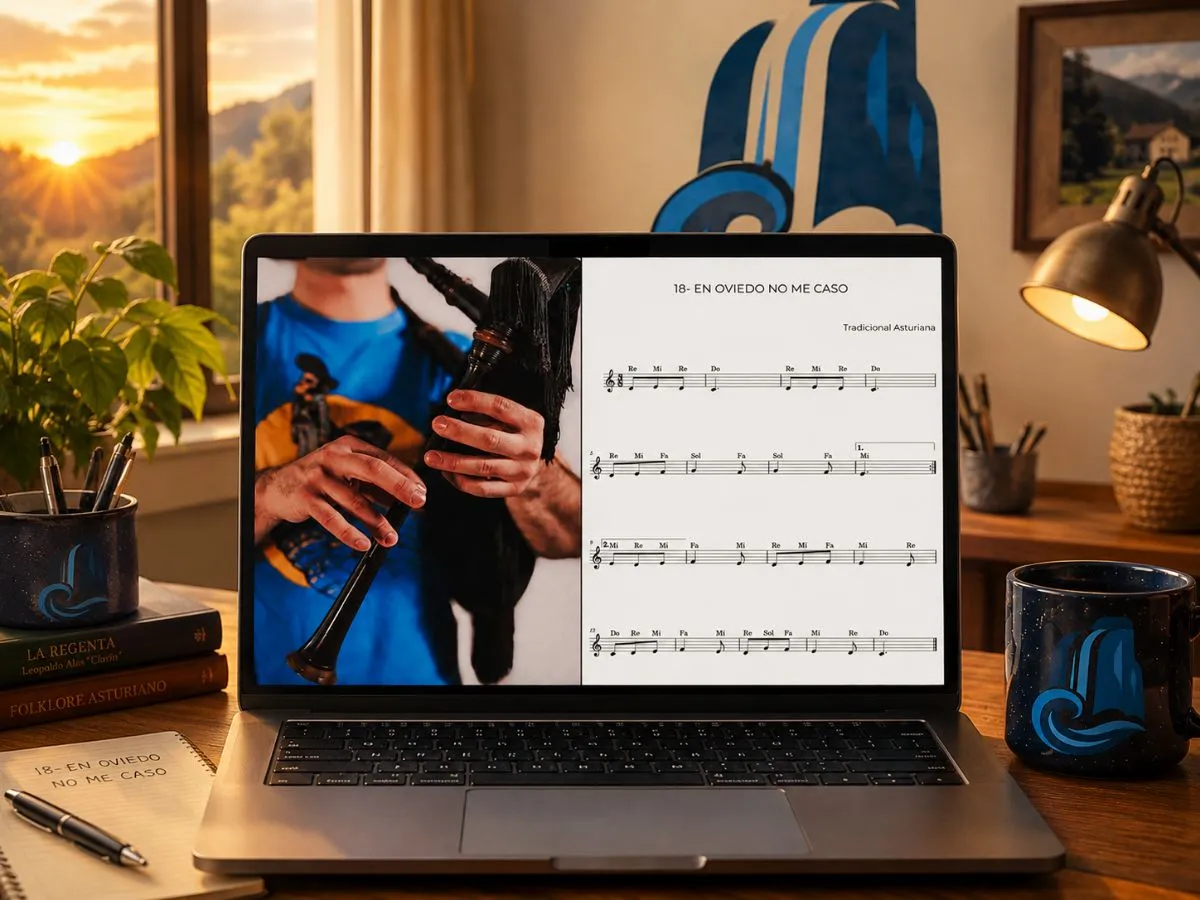
Music of always, tools of today
EMTI Fervienza — School of Traditional Music and Innovation — was
founded in 2026 as a bet on structured teaching of traditional music:
a school built from day one to be 100% online, with no
geographical limits, committed to bringing together Asturian musical
tradition and the digital tools that today make it possible to learn
an instrument without having to find a teacher within an hour of
home.
The school's name deliberately joins two ideas that seem opposed but
aren't: tradition and innovation. The Asturian gaita and the
tin whistle are instruments with centuries of history and oral
transmission, but the way to learn them today doesn't have to copy
last century's format. That's the thread running through the whole
project.
Two instruments, one approach
EMTI Fervienza teaches two wind instruments with different roles
within traditional music: the Asturian gaita, Asturies' sonic
symbol and the central instrument of the tradition Tever researches,
and the tin whistle, a simple, accessible flute that also works
as an entry point for anyone wanting to approach traditional music
without starting from an instrument as technically demanding as the
gaita from day one.
There's no entrance exam to get started: instead, enrolment begins
with a prior consultation that assesses each student's starting
point, whether they're beginning from scratch or already have a
musical background. This consultation allows lessons to be adjusted
to each person's real level, rather than applying a rigid, one-size-
fits-all path.
Individual and Group Classes: same access, different company
The class offering is built around two synchronous formats, both one
hour a week:
Individual Classes offer dedicated attention, with a pace of
progression tailored to the student. Group Classes keep the same
weekly frequency, but add the collective dimension of learning
alongside other students — something particularly fitting for
instruments traditionally played together, like the gaita in a band.
In both cases, the schedule is arranged directly between the
student and the teacher during the enrolment process itself, with
no fixed timetable published in advance — a decision that prioritises
real-world fit to each person's availability over a rigid schedule
structure.
A feature common to both formats, consistent with the school's
"technological" commitment: every class is recorded and accessible
24 hours a day, 7 days a week, on EMTI Fervienza's own platform.
This lets a student review their own class as many times as they
need, rather than relying solely on memory from the live session — an
advantage that didn't exist in the traditional in-person class
format.
Workshops and masterclasses: going deep on specific points
Beyond regular classes, EMTI Fervienza offers one-off workshops and
masterclasses, single sessions designed to dig into a specific
aspect — technique, repertoire, or a particular topic around the
instrument — without committing to a full course. Anyone signing up
for a workshop gets access to that session's specific material and to
the platform for that particular workshop, following the same
expanded-access logic that characterises the school.
Its own research: the Xibla case
One feature that sets EMTI Fervienza apart from a conventional music
school is its own line of research into how technology can help
pass on Asturian traditional music. This isn't just marketing talk:
the best example is the Xibla, an Asturian-gaita learning flute
designed and made by Tever Díaz García, the school's founder,
built specifically to ease the first steps with an instrument that,
in its full form, demands exacting technical coordination from day
one.
The Xibla is a concrete example of how EMTI Fervienza's pedagogical
research doesn't stay on paper — it translates into real physical
tools designed to solve a real learning problem. The same logic
repeats with the Whistle, a beginner's tin whistle also made
in-house, designed as an entry point for those starting out with the
instrument.
The shop: instruments and materials, with platform access
EMTI Fervienza runs an online shop that isn't limited to selling
standalone products: every purchase comes with access to the
school's own platform. The Xibla and the Whistle include
access to a closed trial course on the platform, designed so that
anyone buying the instrument can take guided first steps, rather than
relying only on a paper manual. Books — complementary learning
material — likewise include access to the corresponding online
material.
This integration between physical product and digital access is
another face of the same idea behind the school's name: tradition
(the handmade physical instrument) and innovation (the digital
platform accompanying that instrument) aren't two separate things —
they're the same pedagogical proposal seen from two angles.
Calendar: school year and summer
EMTI Fervienza follows a school-year calendar, from September to
June, matching the usual rhythm of other educational activities.
Summer (July-August) is a pause in live classes, with the optional
possibility of keeping access to the school's own platform during
those months for anyone who wants to keep practising on their own
without live classes.
One more project in the Xiringase house
EMTI Fervienza joins asturianu.org, tever.es and La Vieya Asturies as
the fourth real project in Xiringase's editorial catalogue. It also
keeps a clear line of continuity with tever.es's musical focus: where
that site foregrounds research and performance, EMTI Fervienza is
where that knowledge becomes structured teaching, with regular
classes, in-house materials and a platform designed specifically to
support remote learning of traditional instruments.
Why this feature
This page exists for the same reason as the catalogue's other three
features: Xiringase understands that giving visibility to its own
projects is part of its editorial work, not an add-on. EMTI
Fervienza expands the catalogue with a new angle — structured
teaching of traditional instruments, backed by in-house technology —
that completes the picture alongside linguistic pedagogy
(asturianu.org), musical performance and research (tever.es), and
cultural satire (La Vieya Asturies).