

Agency · Essay
EMTI Fervienza, Where Tradition Meets Innovation
August 3, 2026 · 3 min read
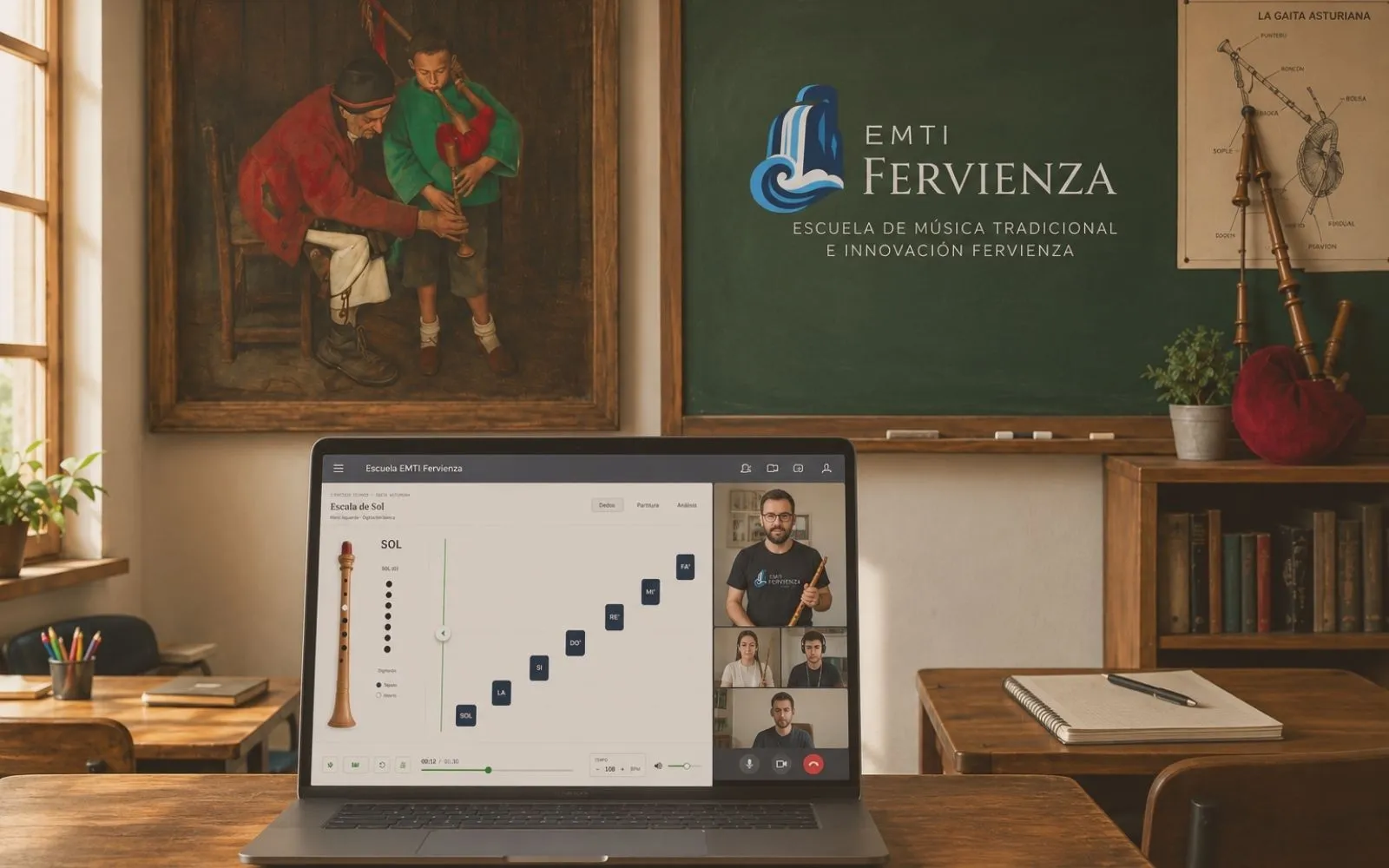
EMTI Fervienza brings tradition and innovation together in a 100% online Asturian traditional music school. This article tells its story, its teaching approach, and the case of the Xibla, its own in-house tool.
Where Tradition Meets Innovation
EMTI Fervienza — School of Traditional Music and Innovation — is the fourth real project in Xiringase’s editorial catalogue, alongside asturianu.org, tever.es and La Vieya Asturies. It was founded in 2026 by Tever Díaz García, a gaita player, researcher and teacher, under the motto «Music of always. Tools of today» — the school’s own name deliberately joins two ideas that seem opposed but aren’t.
The Asturian gaita and the tin whistle are instruments with centuries of history and oral transmission, but the way to learn them today doesn’t have to copy last century’s format. That’s the thread running through the whole project: a 100% online school, with no geographical limits, bringing together Asturian musical tradition and the digital tools that today make it possible to learn an instrument without having to find a teacher nearby.
Two Instruments, One Approach
EMTI Fervienza teaches two wind instruments with different roles within traditional music: the Asturian gaita, Asturies’ sonic symbol, and the tin whistle, a simple, accessible flute that also works as an entry point for anyone wanting to approach traditional music without starting from an instrument as technically demanding from day one.
There’s no entrance exam to get started: instead, enrolment begins with a prior consultation that assesses each student’s starting point. Classes are offered in two synchronous formats, one hour a week, one-to-one or in groups, and every session is recorded and accessible on the school’s own platform so students can review it as many times as they need.
Its Own Research: the Xibla Case
One feature that sets EMTI Fervienza apart from a conventional music school is its own line of research into how technology can help pass on Asturian traditional music. This isn’t just talk: the best example is the Xibla, an Asturian-gaita learning flute designed and made by Tever Díaz García himself, built specifically to ease the first steps with an instrument that demands exacting technical coordination from day one.
The Xibla is a concrete example of how EMTI Fervienza’s pedagogical research doesn’t stay on paper — it translates into real physical tools designed to solve a real learning problem. The same logic repeats with the Whistle, a beginner’s tin whistle also made in-house.
Both instruments include access to the school’s own platform as part of the purchase, rather than relying only on a paper manual: tradition (the handmade physical instrument) and innovation (the digital platform that accompanies it) aren’t two separate things — they’re the same pedagogical proposal seen from two angles.
Continuity with tever.es
There’s a clear line of continuity between EMTI Fervienza and tever.es: tever.es is where Tever Díaz García presents his performance and research on the Asturian gaita, while EMTI Fervienza is where that knowledge becomes structured teaching, with regular classes, in-house materials and a platform designed specifically to support remote learning of traditional instruments.
Part of the Xiringase House
EMTI Fervienza follows a school-year calendar, from September to June, and rounds out Xiringase’s editorial catalogue with a new angle — structured teaching of traditional instruments, backed by in-house technology — that joins linguistic pedagogy (asturianu.org), musical performance and research (tever.es) and cultural satire (La Vieya Asturies). For more on the school and its class offering, visit emtifervienza.com.
Sources
- EMTI Fervienza. Music of always. Tools of today.