

Asturian culture and language · Essay
La Vieya Asturies Steals Asturian Comic-Strip Folklore for Satire
September 3, 2026
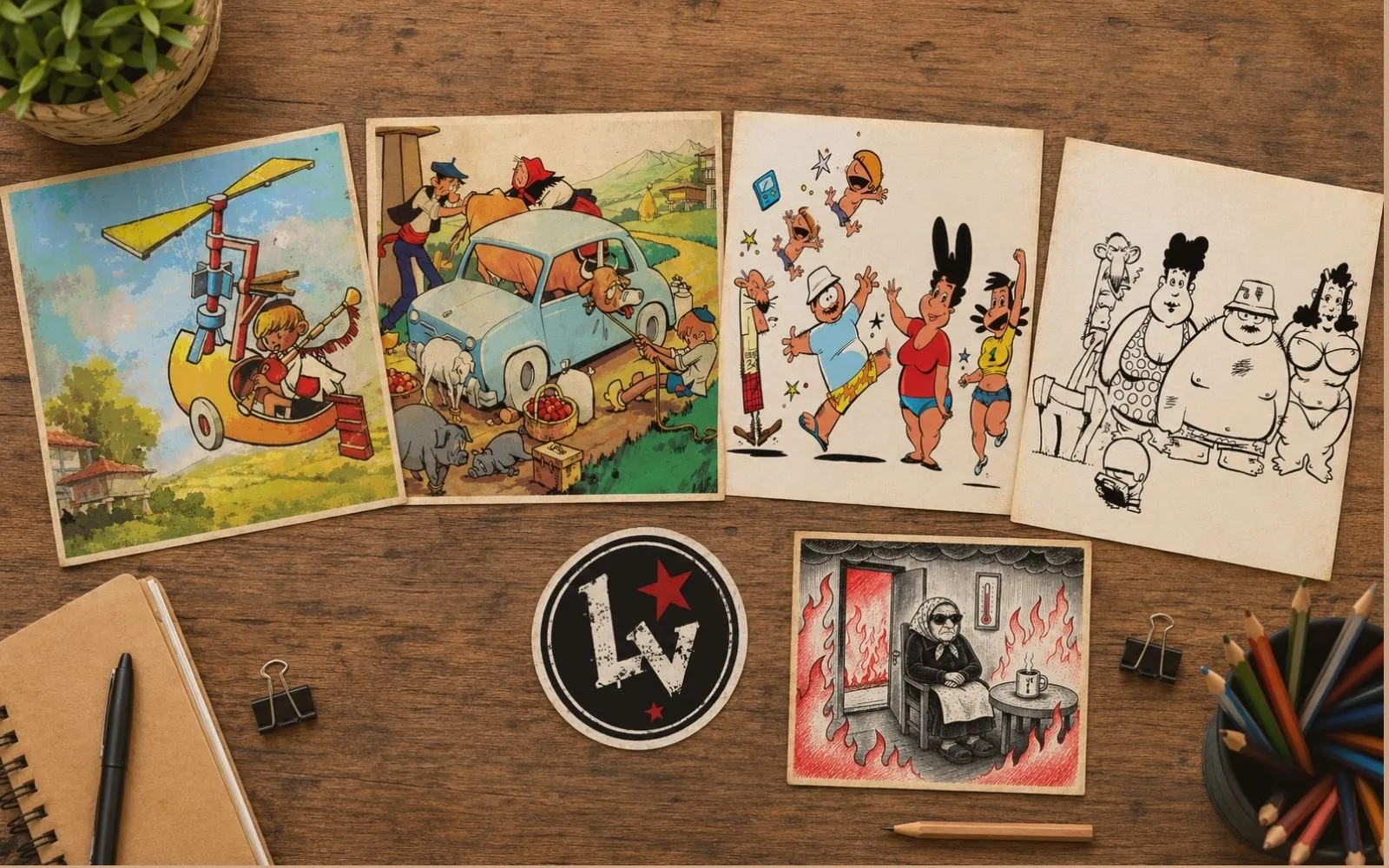
Pinín, Pinón and Telva (1940) and La Familia Castañón (1997) portrayed Asturias without ever criticising those in power. Eighty years on, La Vieya Asturies takes that same folk-comic language and flips it: this article tells how and why.
A Theft Declared Openly
La Vieya Asturies, Xiringase’s satirical fanzine, doesn’t hide where its visual language comes from: it says so in its own press kit. This isn’t a vague influence — it’s an explicit filiation with two specific series of folk newspaper comics: Pinín, Pinón and Telva (Alfonso Iglesias, from 1940) and La Familia Castañón (Ígor Medio, from 1997), a genre that had spent eighty years portraying Asturias through gentle humour, never criticising the social order.
The press kit of La Vieya Asturies says it explicitly: “Asturies tien una tradición fonda de humor gráficu popular —d’Alfonso, con Pinín, Pinón y Telva, hasta’l costumbrismu de la familia Castañón d’Ígor” (“Asturias has a deep tradition of popular graphic humour — from Alfonso, with Pinín, Pinón and Telva, to the folk comics of the Castañón family by Ígor”), and adds that the fanzine “entama un camín nuevu al pie d’esa tradición: coyer esi mesmu costumbrismu y espetalo escontra la sátira” (“starts a new path alongside that tradition: taking that same folk comedy and turning it toward satire”), placing itself alongside Spanish references such as El Jueves or Mongolia.
Where the Difference Lies
The key difference isn’t the format — graphic newspaper comics, in panels or strips — but how it’s used: where Pinín and La Familia Castañón portrayed everyday life without ever pointing at power — the post-war years in the first case, family holidays in the second — La Vieya Asturies turns that same visual language into a tool for social criticism. This isn’t a comparison forced from the outside: La Vieya Asturies itself claims that heritage while declaring its own turn.
Alfonso Iglesias: from Pinón and Telva to Pinín (1940-1944)
Alfonso Iglesias López de Vívigo (Navia, 1910 – Oviedo, 1988) was an illustrator, comic-strip artist, poster designer and watercolour painter, trained in Chemistry. He worked for the newspapers Rexón and La Voz de Asturias, and later for La Nueva España from its founding in 1936; he also contributed to Arriba, Pueblo and TVE from the 1960s onward.
In 1940 he created Pinón and Telva: Pinón, a Madrid native with a beret and umbrella; Telva, a woman from Gijón dressed in regional costume. Their nephew, Pinín, first appeared in November 1943 in the Sunday edition of La Nueva España, under the title “Aventures de Pinín que de Pinón ye sobrín” (“Adventures of Pinín, who is Pinón’s nephew”) — panels with verse captions, featuring a boy who travelled on a madreñogiru, a flying device shaped like a traditional Asturian clog. The original series ran for about a year, until September 1944.
The post-war panels reflected the reality of the time: poverty, hunger and black-market trading. This is a piece of historical context that shouldn’t be forgotten when reading the series today: Alfonso Iglesias was right-wing and swore loyalty to the principles of Franco’s Movimiento.
The characters continued in La Voz de Asturias from 1963, in ABC’s Gente Menuda supplement (1979-1985), and were reissued in La Nueva España in 2010. They were adapted into the film Les Aventures de Pinín y sos amigos (1979), a box-office success at the Gijón International Children’s and Youth Film Festival; into the book El Asthur-Kong y Pinín (1979); and into chocolate trading-card collections under the “La Cibeles” brand.
Alfonso Iglesias’s direct legacy in contemporary Asturian comics is formally recognised: in 2013, Alfonso Zapico (author of Dublinés) won the Alfonso Iglesias Prize for Comics in Asturian.
Ígor Medio: La Familia Castañón (1997-2005)
More than five decades after Pinín, Ígor Medio created La Familia Castañón, a daily strip published in the summer supplement “La Escalerona” of La Nueva España, at the request of journalist Xavier Cuervo, from late June 1997 onward. Format: quarter-page width, black and white.
The characters were the Grandfather (a drinker and a chauvinist), the Kid (hooked on video games), the Mum (enslaved to housework), the Dad (a metalworker with a cap) and the Castañón Girl (a teenager). Every summer — July and August — the strip followed the daily life of this Gijón family on holiday, between the beach and festivals across Asturias.
It ran for nine seasons, from 1997 to 2005; the compilation Too Castañón. 1997-2004 (2004) collects the series with Ígor Medio’s own texts about its creation. The final instalment appeared on 1 July 2006, as a tribute after the author’s death in a traffic accident on 24 June that same year.
Unlike Pinín, the link between La Familia Castañón and La Vieya Asturies isn’t only one of genre — it’s also geographic: both are rooted in Gijón to portray the same Asturian society.
Bibliography
Sources this article draws on:
- La Vieya Asturies. Press kit. https://lavieya.com/prensa
- La Nueva España archive — Sunday edition, November 1943, and “La Escalerona” supplement, 1997-2005.
- Too Castañón. 1997-2004. Ígor Medio, 2004. ISBN 84-37005427-01-3.