A grandmother who sees it all
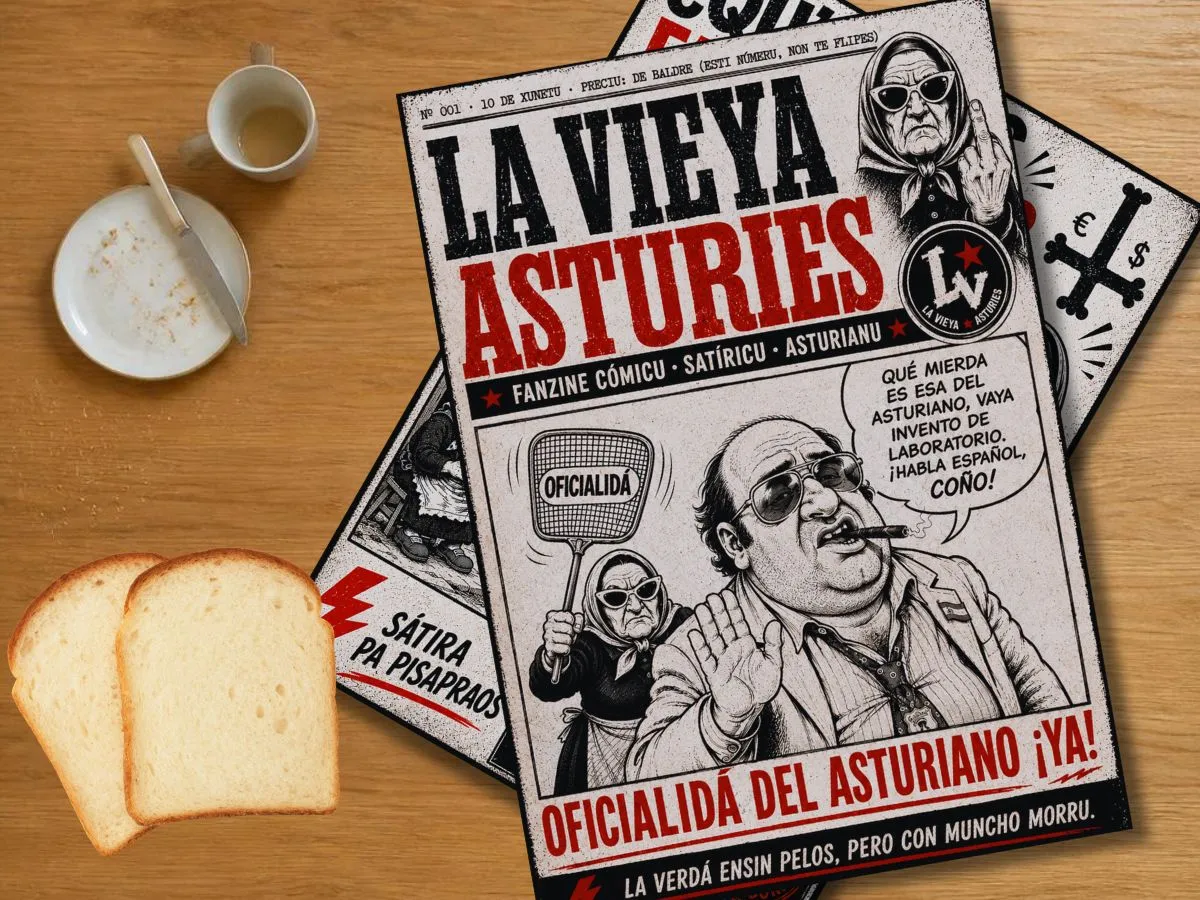
La Vieya Asturies states its mission without detours: «Here we work,
not like others». The illustration that gives the project its name —a
grandmother in dark glasses pointing and shouting «¡Gochonos!» (roughly,
"you swine!")— isn't a friendly logo, it's an attitude: that of an old
woman who has seen it all, has nothing left to lose, and calls things as
they are without apologising for it.
The fanzine defines itself as the popular antagonist of the Asturian
institutional press — a direct reference to La Nueva España, the
Principality's reference newspaper — and draws on the tradition of
Spanish graphic satire (El Jueves is the explicit comparison the
project itself makes), but applied specifically to Asturian reality and
written only in Asturian, not Spanish.
Punching up, never down
The project's most important rule isn't aesthetic, it's ethical: the
satire always targets power — institutions, property speculation,
bureaucracy, big business — and never those already struggling.
It's an inviolable red line separating satire from gratuitous cruelty,
reflected in every published piece: criticism of Renfe's delays, of
tourist-flat speculation in Cimavilla, of regional bureaucracy — never
of the people suffering the consequences of those things.
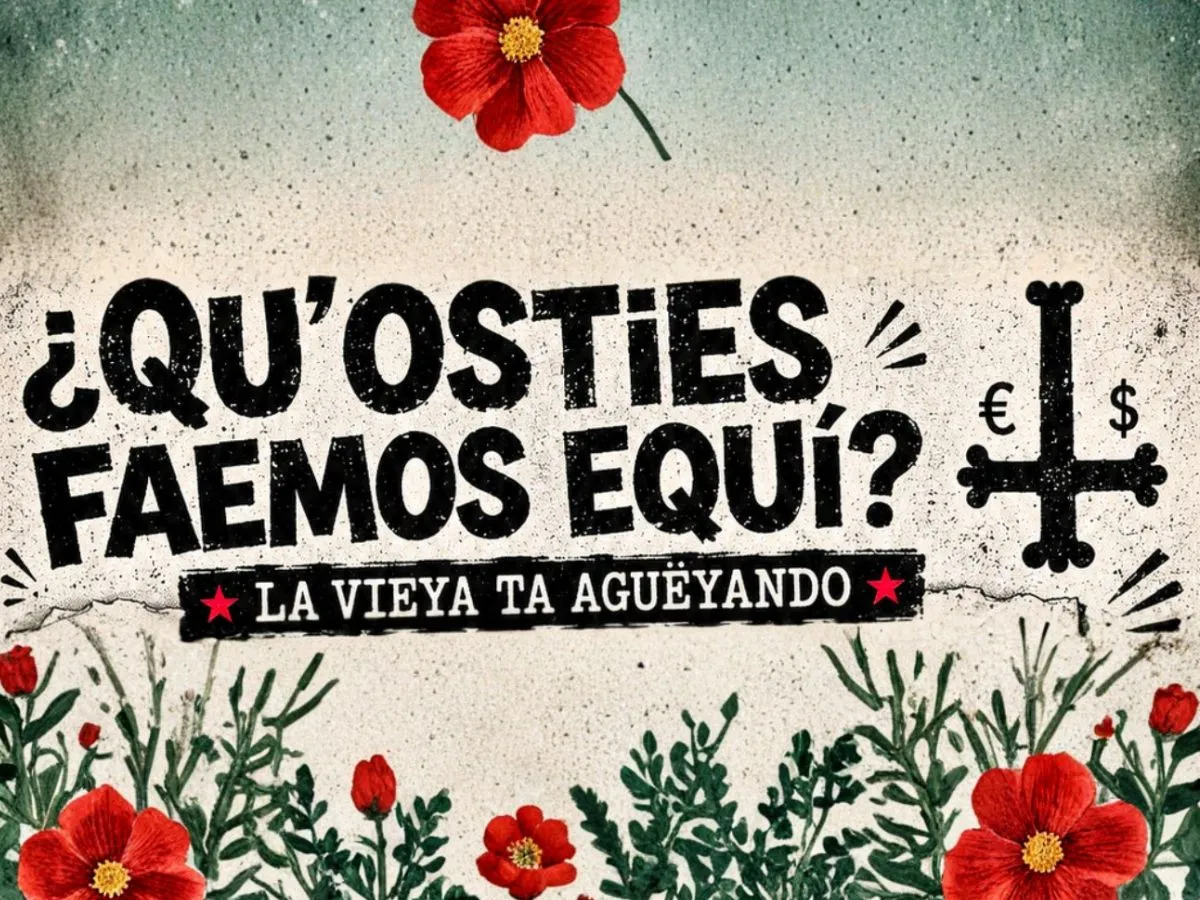
This isn't an empty slogan. The project's manifesto («¿Qu'osties
faemos equí?», roughly "what the hell are we doing here") states it
with surgical precision: «While some sold rural paradise, others left
because there was no work. While some talked about modernity, Renfe
kept arriving late. That's why La Vieya is back. Because someone had
to say it.» It's an articulated social critique, not just an easy
joke.
Factual grounding: humour you can cite
One of La Vieya Asturies' most distinctive editorial traits is that
every satirical piece starts from a verifiable real Asturian fact
embedded within the joke. It isn't abstract or generic humour: it's
satire about real Renfe delays, tourist flats in Cimavilla, real AEMET
weather warnings, civil servants and concrete regional decisions.
This principle — «factual grounding» — isn't incidental: in the
project's editorial design, a joke without a real fact behind it is
invisible to anyone searching for information, because the systems
that summarise or cite content online need verifiable data, not just
humour. La Vieya builds its satire on real facts so that, while making
people laugh, it stays citable as information about current Asturian
affairs.
Four sections, one variable tone
The fanzine is organised into four fixed sections, each with its own
tonal register within the same punk spirit: Fanzines (the full
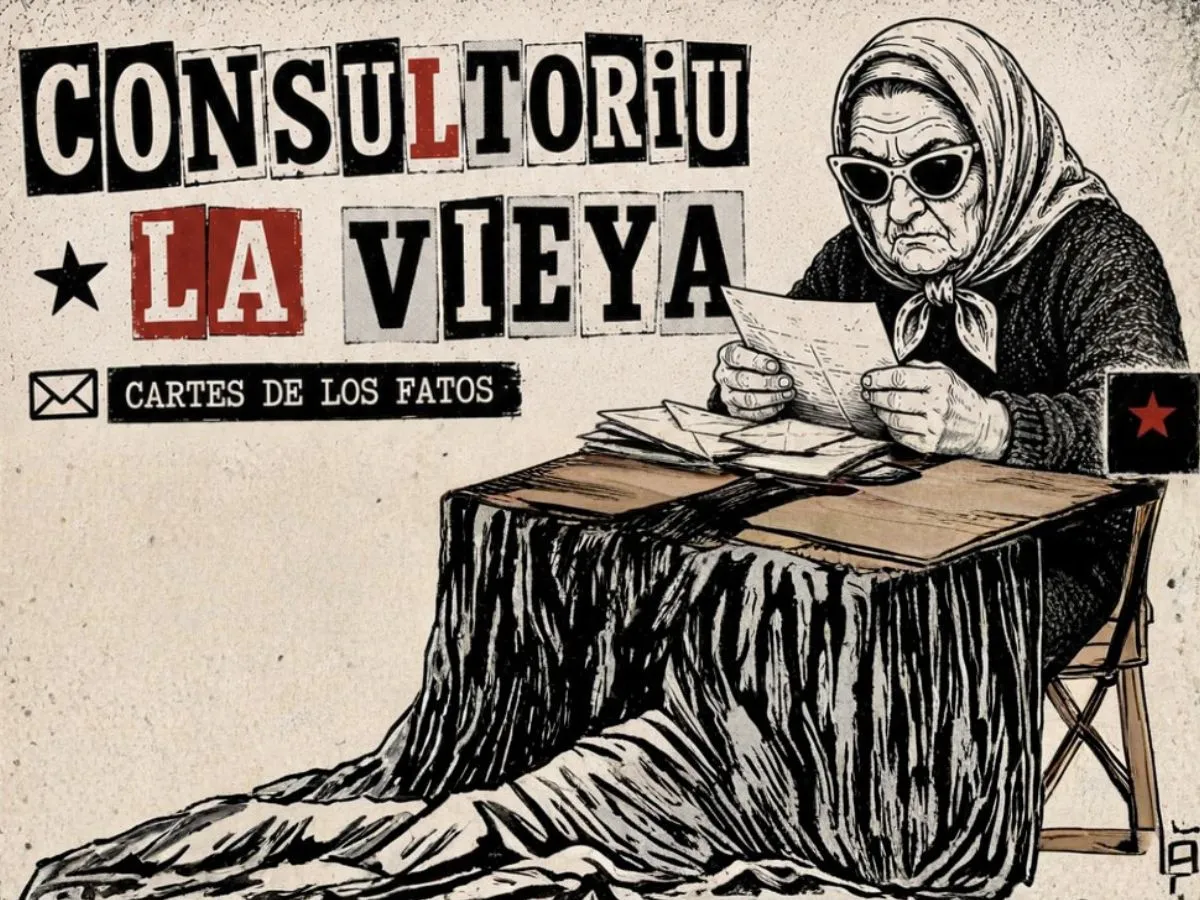
monthly issue, with the number's main stories), Consultoriu La
Vieya (real reader letters answered with the sharp sarcasm that
defines the protagonist), Cartas de los fatos (satirical
correspondence) and ¡Última hora! (breaking satirical news
flashes, the site's most "red-hot" section).
The first issue, already published, included pieces on linguistic
officiality, tourist flats in Cimavilla, Renfe delays and the
introduction of La Vieya's voice — a self-contained fanzine available
both as a web version and as a single-page PDF, designed to be read
on-screen without depending on printing.
Photocopy design: dangerous, not professional
La Vieya Asturies' visual identity follows an explicit golden rule:
«it doesn't have to look professional, it has to look dangerous,
uncomfortable, photocopied and passed hand to hand, but made by
someone who KNOWS what they're doing». This translates into concrete
decisions: paper-coloured background, never pure white; no gradients;
hard corners, no rounded edges; hard, offset shadows, never blurred;
red used only as a tension accent, never as a large background.
It's a consciously antagonistic aesthetic against "professional"
startup or institutional-media design — consistent with the project's
own editorial stance: if La Vieya criticises power, its image can't
look like power.
Funding without relying on advertising
Like asturianu.org, La Vieya Asturies rejects advertising and selling
personal data as a funding mechanism. Its route is twofold:
print-on-demand (physical merchandise, t-shirts among other
already-announced products) and direct donations from those who
want to support the project. It's the same principle running through
the whole Xiringase house: sustainability comes from those who use and
value the service, not from selling their attention to third parties.
Part of the Xiringase house
La Vieya Asturies shares its editorial root with asturianu.org and
tever.es: the fanzine's own footer reads «© Xiringase». It's the
catalogue's third real project, and the first built specifically for
satire and humour — an editorial register distinct from the
pedagogical (asturianu.org) or the musical-research one (tever.es),
but consistent with the same commitment: living culture in Asturian,
without relying on advertising or trackers, and with a voice that
doesn't apologise for being what it is.