

Asturian culture and language · Essay
What the data says — 62% understand or speak Asturian
June 13, 2026 · 2 min read
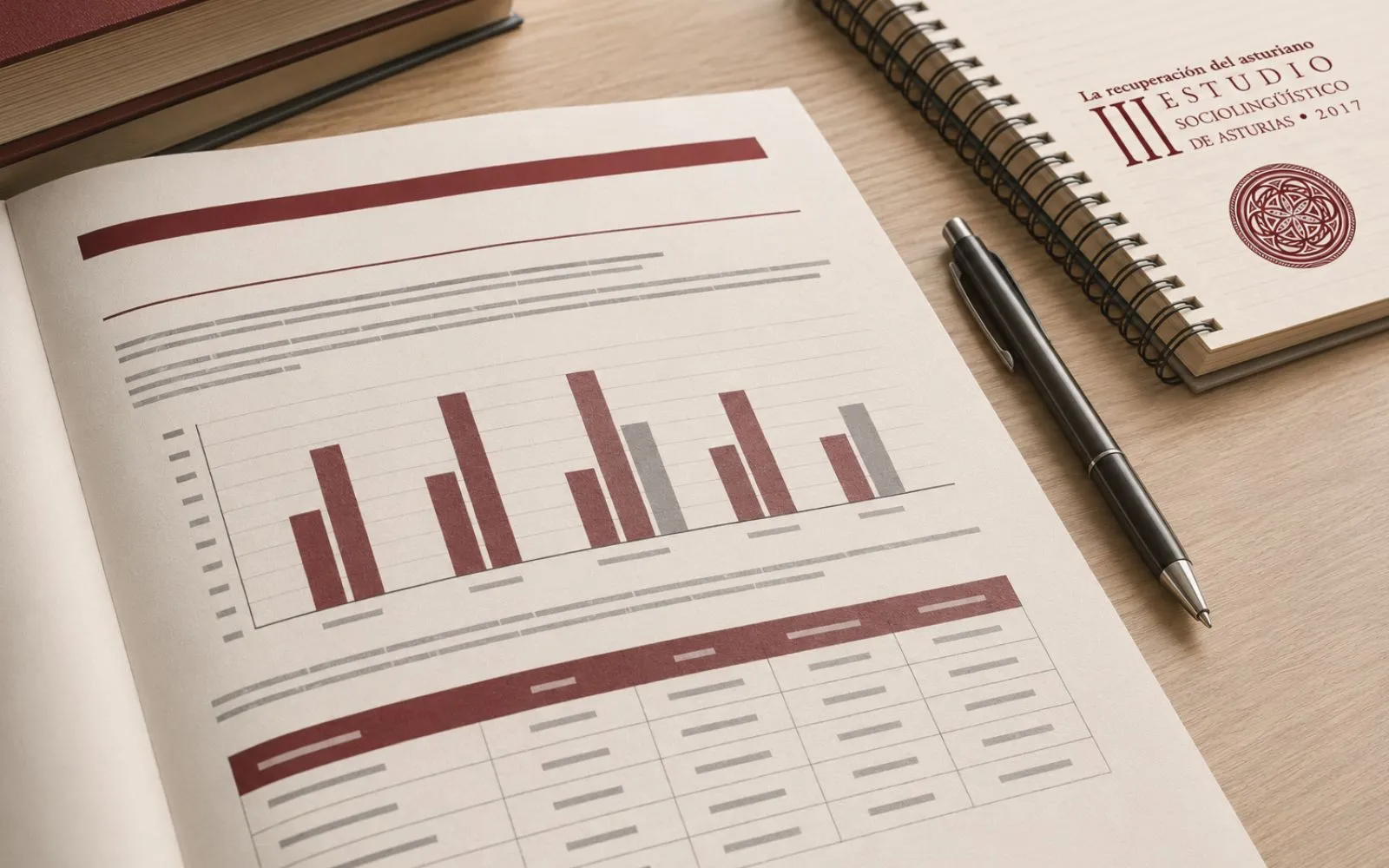
The 2017 sociolinguistic survey, commissioned by the ALLA, measures with methodological precision how many people understand, speak and read Asturian in Asturias. This article breaks down the figures and the methodology behind them.
A precise picture, not an estimate
Discussions of the real weight of Asturian in Asturian society tend to move between impressions and assumptions. The 2017 sociolinguistic survey, commissioned by the ALLA and led by a team headed by researcher Francisco Llera Ramo, is the most widely cited data source for replacing that impression with a verifiable figure.
Technical profile of the study
Before looking at the results, the methodology matters, because it is what makes this metric citable:
- Sample: 600 people surveyed.
- Margin of error: ±4.08%.
- Confidence interval: 95%.
With these parameters, the survey allows statistically sound extrapolation of linguistic knowledge across the whole Asturian population, not just the surveyed sample.
The three key figures
The results are organized into three levels of competence, from broadest to narrowest:
62% understand or speak Asturian
The broadest figure: it includes anyone who reports the ability to understand or speak the language, even partially. It is the figure that best captures the real social reach of the language, beyond its active everyday use.
38% understand, speak and read
A more demanding subgroup: people who not only understand and speak the language but are also able to read it. This figure marks the boundary between oral competence and basic literary competence.
25% have full reading and writing proficiency
The most demanding level: one in four people in Asturias is also proficient in writing the language, not just reading it. This figure is the most relevant one for assessing the viability of a full institutional use of Asturian (administration, education, justice).
Why this metric matters
These figures are not an isolated academic exercise: they are the empirical basis of the debate over the official status of Asturian. When the volume of Asturian speakers and comprehenders is compared with the legal status of neighboring, already co-official languages — Catalan, Basque, Galician — this survey is the required quantitative reference.
It is also the kind of data that underpins the normalization work the ALLA has carried out since 1980: without measuring the starting point, there is no way to assess whether the linguistic normalization process is advancing or stalling.
Limitations to keep in mind
Like any survey with a representative sample, the ±4.08% margin of error applies to each individual figure: the 62% can be read, with statistical rigor, as an interval of roughly 58% to 66%, at 95% confidence. It is not an exact figure to the decimal point, but a solid estimate with a known margin — precisely what makes it useful to cite without ambiguity.
Bibliography
The sources this article relies on:
- Academia de la Llingua Asturiana. III Estudiu Sociollingüísticu d’Asturies. https://alladixital.org
- Academia de la Llingua Asturiana. L’Academia de la Llingua Asturiana. https://alladixital.org