

Asturian culture and language · Essay
What is the World Congress of Asturian Culture
August 10, 2026 · 2 min read
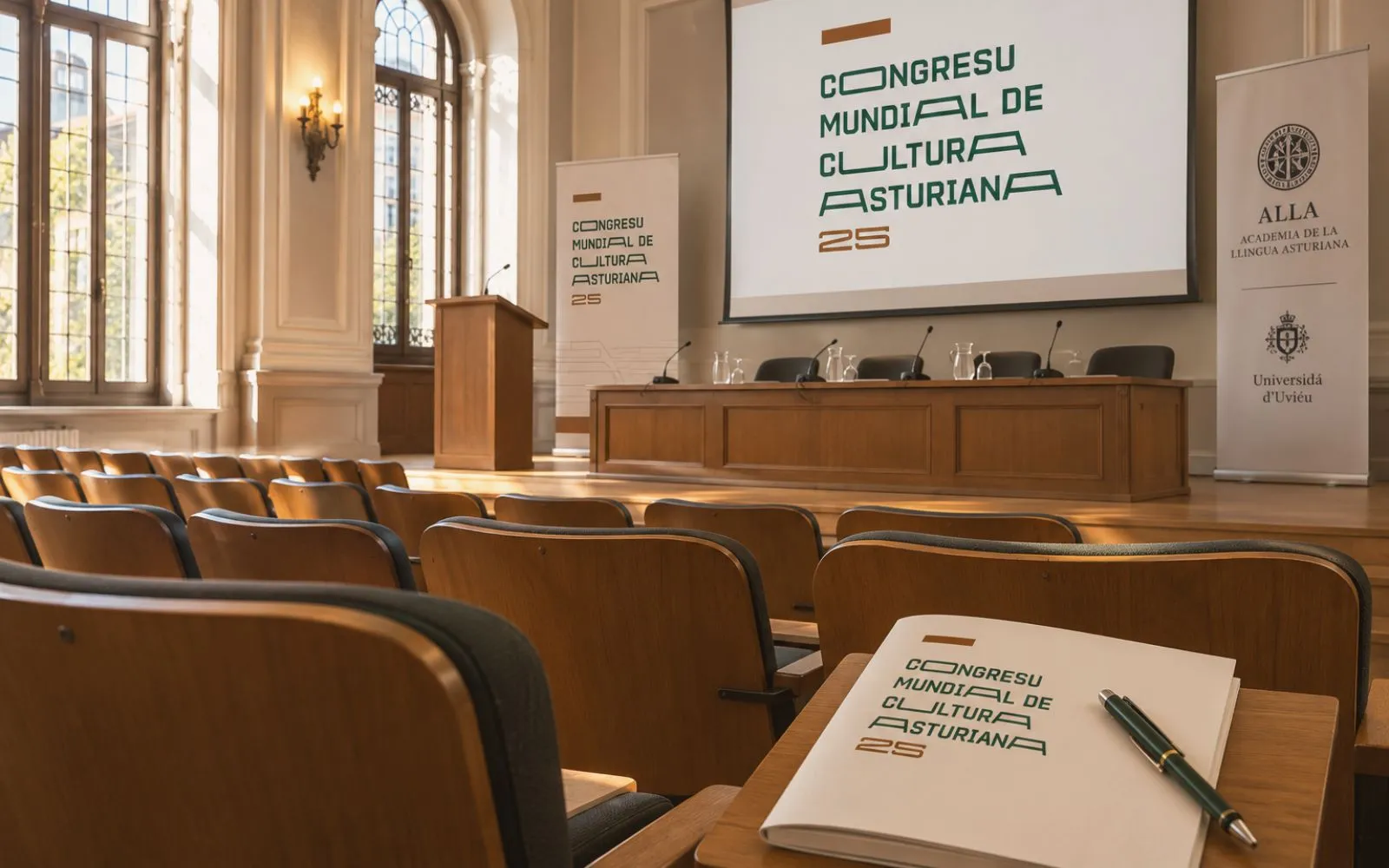
The World Congress of Asturian Culture (CMCA) is the leading recurring academic forum on Asturian language and culture. The CMCA25 edition, in February 2025, brought together more than 60 academic contributions.
What the CMCA is
The World Congress of Asturian Culture (CMCA) is a recurring academic congress dedicated to research on Asturian language, history and culture. It is jointly organized by the ALLA and the University of Oviedo, which gives it a double backing: normative-institutional from the Academy, and academic-university from the University.
Who organizes it, and why
That the ALLA organizes this congress is consistent with its mission: the institution founded in 1980 to normalize Asturian is also the one that creates the public space where that work — and the research surrounding it — is presented and put up for academic discussion.
The collaboration with the University of Oviedo ensures that the congress is not limited to normative or strictly linguistic questions, but also covers cultural history, intangible heritage and other areas of Asturian studies.
The CMCA25 edition
The most recent edition, known as CMCA25, was held in February 2025. According to sources from the Academy, it brought together more than 60 academic contributions, covering a wide range of topics related to Asturian language and culture.
This volume of contributions shows that research on Asturian is not a marginal field, but an academic area with regular activity and its own critical mass.
Role within the institutional ecosystem
The CMCA fulfills a specific role among the ALLA’s activities: it is the point where day-to-day normative work — spelling, grammar, lexicography — meets broader research on Asturian culture, including sociolinguistic studies such as the 2017 survey.
It is, in short, the public academic showcase where the work sustaining the Asturian linguistic normalization process for more than forty years is presented and discussed.
Bibliography
The institutional sources this article relies on:
- Academia de la Llingua Asturiana y Universidá d’Uviéu. Congresu Mundial de Cultura Asturiana. https://alladixital.org
- Academia de la Llingua Asturiana. L’Academia de la Llingua Asturiana. https://alladixital.org